Android GPU Debugging
I am currently working on improving the custom Vulkan renderer that powers PeakVisor’s Android app. It is one of the key features that sets the app apart f...

Hi there, great to see you around! My name is Johannes Unterguggenberger. I've been working for the Research Unit of Computer Graphics at TU Wien for a couple of years, where I completed my PhD in 2025. I also briefly worked as a Senior Computer Graphics Architect at Huawei Technologies. Today, I work as an independent contractor.
I specialize in contract work as a real-time rendering engineer and researcher, with a focus on graphics APIs, engine development, GPU programming, and shader optimization. I also have experience in Windows and web development. My core technical expertise includes the Vulkan API, C++, C#, and the Unity game engine. In addition to programming and research, my strengths include teaching, creating educational videos, and delivering engaging presentations. If you’re interested in discussing contract opportunities, please don’t hesitate to get in touch via email or LinkedIn.
This website contains several posts, mostly about real-time rendering and related topics. The posts also include paper pages of my research publications. Please use the Disqus-sections at the bottom of each blog post (available after accepting cookies) to discuss the respective topic.
First Author Papers:

My Vulkan Lecture Series on YouTube has gained some attention and should be very helpful with understanding the concepts of the Vulkan API. It has also been linked on The Khronos Group's vulkan.org website under learning resources. The Vulkan Lecture Series represents the way how I think that learning Vulkan should be approached, s.t. maximum understanding can be gained.
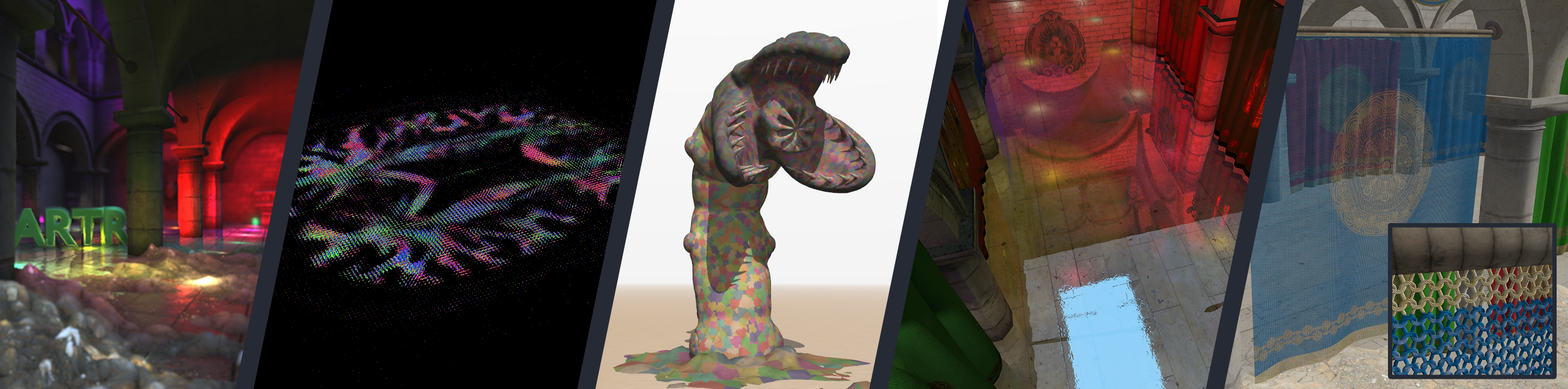
For all the work shown in the Title Image, I have used the Auto-Vk-Toolkit framework, which adds a lot of convenience for Vulkan development. While it probably should get some updates here and there, it has proven to be quite effective for rapid prototyping, research, and also in teaching graduate students the concepts of Vulkan from a slightly higher API abstraction level.
At Huawei Technologies, I was still working in the field of real-time rendering, mostly implementing algorithms, optimizing GPU performance, and doing research in this field—which is arguably the greatest field of them all within computer sciences, and ever will be.I am currently working on improving the custom Vulkan renderer that powers PeakVisor’s Android app. It is one of the key features that sets the app apart f...
Mesh shaders represent a notable evolution in modern graphics pipelines. They are often positioned as a potential “silver bullet” capable of replacing the tr...
This is the paper page of our paper “Fast Rendering of Parametric Objects on Modern GPUs”, which has been accepted for The Eurographics Symposium on Paralle...
This is the paper page of our paper “Vulkan all the way”, which is an extended edition of our previous paper The Road to Vulkan: Teaching Modern Low-Level A...
When using floating point variables, there’s always the danger that a certain number cannot be represented exactly. Therefore, oftentimes epsilon values need...